


Your toddler is a tiny, sticky-fingered wrecking ball, and your current laundry pile is just a graveyard of failed financial decisions. It's a cold, hard truth that most kids' brands sell you overpriced tissue paper disguised as outfits. You've seen the tragedy. That 3T graphic tee goes into the wash once and comes out looking like a crop top for a Chihuahua, with a logo peeling off like a bad sunburn. Since the average parent replaces 12 pieces of clothing per month due to fabric failure, it's clear the industry thinks you're a sucker.
We agree that dressing a human tornado shouldn't feel like lighting your paycheck on fire. You deserve durable toddler clothes that actually survive the playground-pocalypse without making your kid look like a thrift store reject. I'm giving you the ultimate checklist to find gear that stays bold and bright through 45+ aggressive scrubs. We're diving into the fabric blends that refuse to shrink and the construction secrets that keep seams from exploding during a mid-mall tantrum.
Key Takeaways
- Stop flushing cash on "fast fashion" rags that die after one wash and learn why cheap tees are a total scam for parents of tiny terrorists.
- Master the "fabric physics" of GSM and seam integrity to identify durable toddler clothes that can actually survive a playground-pocalypse.
- Use our 10-point checklist to spot the difference between a high-impact shirt and a glorified napkin before you hit the checkout.
- Learn the "inside out" laundry secret and other zero-filter tips to keep your kid’s gear looking fresh instead of like a thrift store reject.
- Discover how to dress your lovable antagonist in premium fabrics that handle both the sandbox and the washing machine like a total boss.
Why Most Toddler Clothes Are Trash (and Why You Should Care)
Let's be honest. Most toddler gear is designed to survive a single staged photo op, not a real-life afternoon in a sandbox. If a shirt can't handle a face-plant in the mud followed by a 60-minute scorched-earth cycle in the wash, it belongs in the bin. We define durable toddler clothes as gear engineered for high-impact chaos and industrial-strength laundering. Your kid's attitude is 100% unfiltered; their wardrobe shouldn't be 100% disposable.
You see a $5 tee at a big-box store and think you're winning at life. You aren't. That "deal" is a fast-fashion trap designed to fail. When you have to replace that limp, grey rag three times in six months, you've spent $15 on garbage. Investing in high-quality little sasshole toddler shirts might cost more at the checkout, but they actually survive the toddler years without looking like they were rescued from a shipwreck.
Then there's the emotional trauma of "The Shrink." You pull your favorite outfit out of the dryer and it's suddenly a crop top for a doll. It's a betrayal of the highest order. A study of Children's clothing history shows that while styles change, the need for functional, shrink-resistant fabric is eternal. If the shirt can't keep its shape, it's just a very expensive dust rag.
The Anatomy of a "One-Wear" Shirt
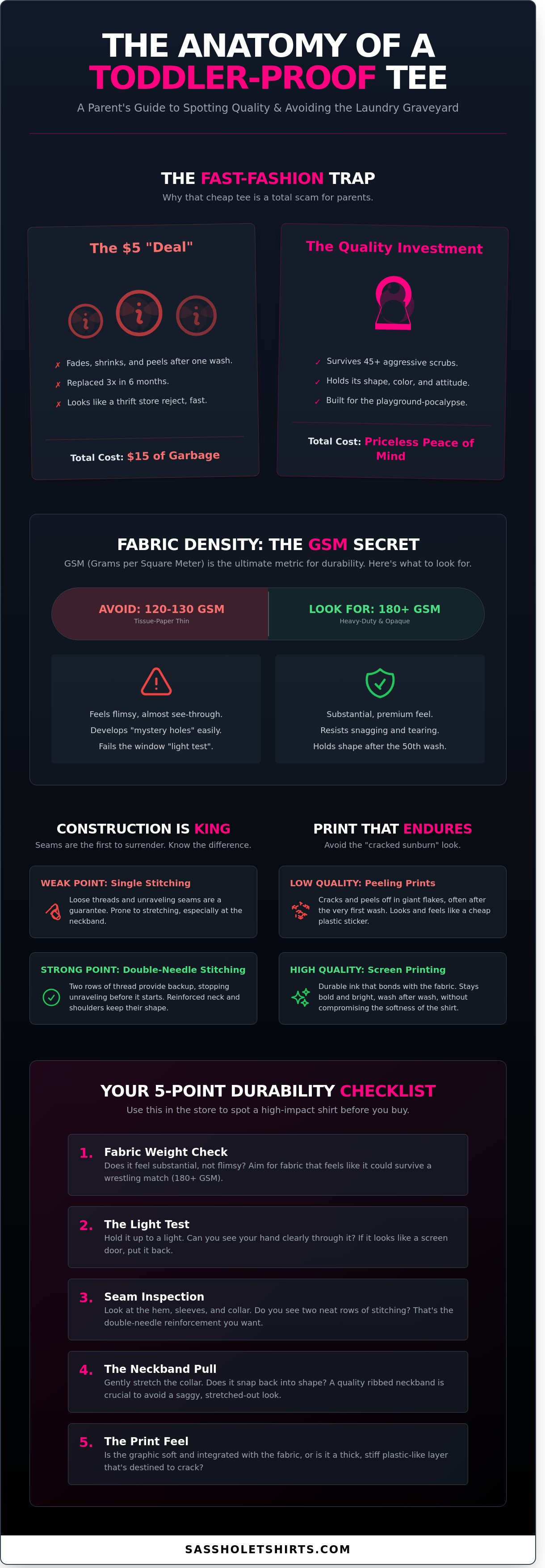
Spotting a loser shirt is easy if you know what to look for. Avoid "tissue-paper" fabrics. If you can see your hand through the cotton, it will develop "mystery holes" by Tuesday. Cheap dyes are another red flag. If the vibrant red looks like a sad pink after 2 washes, the manufacturer cut corners. Check the seams before you buy. If you see loose threads or uneven stitching in the store, that shirt will literally unravel the second your kid decides to climb a fence.
Durability vs. Sustainability: The Truth
Don't get blinded by the "organic" label. Just because a fabric is natural doesn't mean it's tough. Some organic cotton is as fragile as a toddler's ego during a nap-time negotiation. The real sustainability flex is buying gear that lasts through three siblings or holds its value for resale. Quality prints are part of that math. High-end screen printing won't peel off in giant flakes, saving you from the "homeless chic" look of a cracked, half-missing logo. Buying 1 shirt that survives 40 washes is always smarter than buying 5 that die after 10.
The Fabric Physics: What Makes Clothes Actually Last
Most toddler shirts are essentially disposable napkins with armholes. Your kid is a one-person wrecking crew. If you are buying flimsy fabric, you are just throwing money into a diaper pail. To find actual durable toddler clothes, you have to look past the cute dinosaur print and check the physics of the fabric itself. It is the difference between a shirt that lasts a season and one that ends up in the trash by Tuesday.
GSM: The Secret Number for Parents
GSM stands for Grams per Square Meter. GSM is the ultimate metric for toddler gear longevity. Most budget brands use a measly 120 or 130 GSM because it is cheaper to produce. You want the heavy stuff. Look for 180 GSM or higher if you want the shirt to survive more than three trips to the playground. High-density fabric does not just feel better. It resists the snagging and tearing that happens when your toddler decides to crawl through a rose bush for no reason.
Try the light test. Hold the shirt up to a bright bulb or a window. If the fabric looks like a screen door and you can see the neighbors through it, put it back. It is garbage. Thick fabric provides better Wearability and holds its shape after the 50th wash. If you want to see what real quality feels like, check out the little-sasshole-toddler-shirts collection for gear that actually stands up to the chaos.
Stitching and Seams: The Invisible Heroes
The seams are usually the first thing to surrender during a toddler meltdown. Look for double-needle stitching on the sleeves and hem. This means there are two rows of thread instead of one. It provides a backup when your kid tries to pull their shirt off over their shoes. It stops the unraveling before it starts. If you see single threads hanging off a new shirt, run away.
- Reinforced Neckbands: Without a ribbed, high-quality neckband, that head hole will eventually stretch out. It becomes a shoulder hole. Nobody wants their kid looking like they are wearing a 1980s off-the-shoulder dance costume.
- Shoulder-to-Shoulder Taping: This is a tiny strip of fabric sewn over the seam at the back of the neck and shoulders. It prevents the shirt from stretching out wide and losing its structure. It is the hallmark of a shirt that was not made in a rush.
Do not settle for "regular" cotton. Combed cotton is the only way to go. Standard cotton includes short, prickly fibers that pill and itch. Combing removes those bottom-tier fibers. It leaves only the long, strong ones. Combine that with a tiny bit of "sass" in the form of a polyester blend, and you prevent the dreaded sag. Pure cotton can get heavy and weird when wet. A blend ensures the shirt snaps back into place. Finally, demand screen printing. Cheap heat transfers crack and peel after one cycle in the dryer. Screen printing bonds with the fibers. The snarky message stays as bold as your kid’s attitude.
The 10-Point Durable Toddler Clothes Checklist
Your toddler is a 30-pound chaos machine. They don't just wear clothes; they stress-test them to the point of structural failure. Buying cheap, disposable rags is a waste of your time and your coffee budget. If you want durable toddler clothes that actually survive the playground, you have to stop shopping with your eyes and start shopping with your hands. Most "cute" shirts are basically napkins with sleeves. You deserve better. Your kid deserves to look like a boss while they're tearing up the living room.
- Fabric Weight: If you can see your hand through the fabric, put it back. Quality tees usually clock in between 160 and 200 GSM (grams per square meter). Anything less is a single-use tissue.
- Seam Integrity: Give the seams a firm yank. They should fight back. Look for reinforced shoulder-to-shoulder taping; it’s the difference between a shirt that holds its shape and one that looks like a potato sack after two weeks.
- Print Quality: Run your hand over the graphic. If it feels like a thick, rubbery sticker, it will crack before the first juice box is empty.
- Neckline Recovery: Grab the collar and stretch it. It should snap back instantly. Look for ribbed collars with at least 5% spandex to prevent the dreaded "bacon neck" look.
- Colorfastness: Rub a damp white cloth on a small area of the shirt. If the dye transfers, it will ruin your laundry. High-quality gear uses reactive dyes that stay in the fibers, not on your towels.
The "Tug and Stretch" Store Test
Don't be afraid to get a little aggressive in the aisle. Grab the shirt by the side seams and pull. A quality garment has "memory," meaning it returns to its original shape immediately. While you're at it, check for "torque." If the side seams are already starting to twist toward the front of the shirt on the hanger, it will only get worse after a wash. Flip the shirt inside out. If you see a bird's nest of loose threads or more than 4 stitches per centimeter, that shirt is a ticking time bomb. High-quality durable toddler clothes have clean, tight overlock stitches that don't unravel the moment a loose thread gets snagged on a toy.
The Graphic Longevity Audit
Cheap iron-on decals are for amateurs. They crack, peel, and eventually look like a topographical map of disappointment. You want designs that are part of the fabric. Bold, high-contrast graphics, like the ones found in our Little Sasshole collection, are designed to handle the friction of a slide and the heat of a heavy-duty dryer. Use the "Scratch Test" on any graphic you're unsure about. Use your fingernail to pick at the edge of the design. If a 1-millimeter flake comes off, the shirt is trash. You want ink that has been cured properly, ensuring the sass stays as loud as your kid's 6 AM wake-up call.
The Zero-Filter Guide to Making Clothes Last
You spent good money on that shirt. It says something hilarious. It fits perfectly. Don't be the reason it ends up fitting a Barbie doll by next Tuesday. Most people treat laundry like a chore they can half-ass, but if you want durable toddler clothes to actually stay durable, you need to stop sabotaging them in the machine. Research shows that 85% of clothing wear and tear happens in the laundry room, and most of it is entirely self-inflicted.
Before you toss that pile of chaos into the wash, follow these non-negotiable rules for clothing survival:
- The Inside Out Rule: This is the easiest way to save your graphics. It creates a barrier between the screen print and the mechanical friction of the agitator.
- Cold Water Only: Heat is the enemy of cotton fibers. Washing in cold water can extend the life of a garment by 50% compared to hot cycles. It also keeps colors from looking like they’ve been sitting in a dumpster for a month.
- Dish Soap for the Win: If you don't have time for a 12-step soaking process, use blue dish soap. It has been the gold standard for cutting grease and food stains since 1973. Dab it on, wait five minutes, and wash.
Washing for Longevity
Ditch the bleach immediately. It eats through cotton fibers like a toddler through a birthday cake. Use a gentle, clear detergent instead. You also need to stop falling for the Gentle Cycle myth. Most durable toddler clothes are built to handle a normal wash; the gentle cycle is for lace doilies and fragile egos. Unless the tag specifically begs for mercy, a regular cold cycle is fine. Just don't overstuff the machine. Clothes need room to move, or they just rub against each other and pill like crazy.
Drying Without Dying
The dryer is the "toddler-to-doll" pipeline. High heat will shrink a quality cotton tee by up to 10% in a single cycle. If you have the patience of a saint, air-drying is the gold standard for keeping the shape intact. For the rest of us living in reality, use the lowest heat setting possible. It takes longer, but your kid won't look like they’re wearing a midriff-baring crop top by next week.
Forget ironing. Nobody has time for that. Use the "Shake and Flatten" technique. When the shirt comes out of the washer or the low-heat dryer, give it a violent snap and smooth it out on a flat surface. It removes 90% of the wrinkles and keeps the collar from curling into a sad little taco shape. Treat your gear right, and it might actually survive until the next growth spurt.
Little Sasshole: Where Durability Meets Attitude
Let's face it. Your toddler is a tiny, adorable wrecking ball. We built the Little Sasshole Toddler T-Shirt because we were tired of seeing so-called durable toddler clothes that fell apart before the first juice box explosion. Most kids' clothes are designed for a static photo shoot, not a backyard mud pit. We chose premium fabrics that handle the playground and the washing machine like a boss. These shirts utilize 100% combed ringspun cotton with a 4.5 oz fabric weight. This provides the perfect balance between cloud-like softness and heavy-duty resilience. It is soft enough for their sensitive skin but tough enough to survive a high-speed slide or a wrestling match with the family dog. We don't do flimsy; we do gear that survives the chaos of 1,000 park visits.
The graphics won't flake off like your sanity on a rainy Tuesday. We use professional-grade printing techniques where the ink actually bonds to the fabric fibers. Your kid can wear their "Big Personality" on their chest without the design cracking or peeling after just three cycles in the dryer. This isn't just about looking cool. It is about the confidence boost they get from wearing gear that feels as loud and proud as they are. When your kid feels like they own the room, they need a shirt that can keep up with that high-octane energy. Our double-needle stitched sleeves and bottom hem ensure the shirt stays together even when your toddler is trying their best to tear the house down.
Not Just a Shirt, an Identity
Bold kids deserve bold clothes that don't quit. They don't do subtle, so why should their wardrobe look like a beige nightmare? The Sasshole promise is simple: we deliver high-quality gear for unfiltered families who find the humor in the daily grind. We know you are tired of the "live, laugh, love" aesthetic. You want something that reflects the reality of raising a tiny human with a zero-filter policy. Our durable toddler clothes are designed to be the armor your little one needs for their next big adventure. Whether they are demanding snacks for the tenth time or staging a protest against nap time, they should do it in a shirt that matches their vibe.
Join the Unfiltered Club
Parents across the country are finally ditching the boring, flimsy brands that treat childhood like a silent movie. You don't need another thin, generic shirt that shrinks 15% the moment it sees a drop of hot water. You need gear that stays vibrant and intact through 60+ laundry cycles. Ready to upgrade your tiny human's closet? Shop the full Little Sasshole collection now and get them something that actually stands the test of time. Choose gear that survives the chaos, because your kid is too legendary for disposable, cringe-worthy fast fashion.
Stop Buying Disposable Rags and Start Arming Your Toddler
Stop wasting your hard-earned cash on tissue-paper shirts that disintegrate the second your kid looks at a sandbox. You now have the 10-point checklist required to identify durable toddler clothes that actually stand a chance against a tiny human wrecking ball. Real survival starts with 6.0 oz heavyweight premium cotton and double-needle reinforced stitching that handles 2x the playground abuse of typical fast-fashion garbage. Your kid is a force of nature. Stop dressing them like a fragile doily.
Our gear is built for the parents who are tired of seeing graphics peel off after three spins in the dryer. We use professional screen-printing tech guaranteed to look sharp for 50+ laundry cycles without a single crack or peel. It's time to buy gear that matches their attitude and survives their daily path of destruction. Give your kid the confidence to own the room, or at least the sandbox, while you enjoy the fact that you aren't replacing their entire wardrobe every three weeks.
Upgrade your tiny human’s wardrobe with the Little Sasshole collection!
Go forth and let them cause a little chaos. At least their shirt will survive the aftermath.
Frequently Asked Questions
How can I tell if toddler clothes are durable before I buy them?
Stop buying tissue paper and calling it a shirt; you need to check the fabric weight and the seams. Look for a weight of at least 180 GSM to ensure the material can handle a tantrum. Give the hem a 2-second tug. If you hear threads popping or see the fabric stretching into a permanent trapezoid, leave it on the rack. Quality durable toddler clothes use double-needle stitching because single-stitch seams unravel faster than a parent's patience on a rainy day.
Does 100% cotton shrink more than blends?
Cotton is a total diva and can shrink up to 5% during its first encounter with a hot dryer. Blends containing 40% polyester are much more stable because plastic doesn't have feelings or a growth spurt. If you want that pure cotton feel without the shirt turning into a crop top, buy pre-shrunk fabrics or keep your water temperature under 30 degrees Celsius. It's the only way to keep the fit from becoming a joke after one wash.
Are expensive toddler brands actually more durable?
Price tags lie more than a toddler who says they didn't eat the crayon. A $45 designer tee often uses the same 150 GSM cotton as the budget stuff, just with a snobby logo attached. You're paying for the brand's marketing budget, not better construction. Look for reinforced necklines and finished internal seams instead of a high price. If the fabric feels thin enough to see your hand through, it won't last 10 minutes on a playground.
How do I stop my kid’s graphic tees from cracking in the wash?
Turn the shirt inside out and stop treating your washing machine like a heavy-duty blender. High heat kills screen prints 100% of the time by making the ink brittle and sad. Use cold water and keep the shirt out of the dryer if you want that snarky slogan to survive 50 cycles. Heat is the enemy of cool; air drying keeps the graphic flexible and prevents your kid from looking like they're wearing a shattered mosaic.
What is the best fabric for active toddlers who love the playground?
A 60/40 cotton-poly blend is the undisputed king of the jungle gym. It handles the friction from 20 trips down a plastic slide while staying more breathable than pure synthetic trash. You need durable toddler clothes that won't pill or tear the second they touch woodchips. This specific blend stays soft against their skin but has enough backbone to survive a daily wrestling match with the dirt.
Is it better to buy a size up to make clothes last longer?
Buy exactly one size up unless you want your kid to look like they're wearing a literal potato sack. Toddlers grow an average of 2 inches every 6 months, so sizing up gives you about 180 days of extra wear. Just check that the neckline isn't so wide that it sags off their shoulders. A shirt that fits like a tent is just a tripping hazard waiting to happen, and nobody has time for more Band-Aids.
Can I really dry high-quality toddler clothes in a dryer?
You can, but only if you use the low heat setting for 20 minutes or less. High heat is a murder machine for clothing fibers and will bake the life out of even the best materials. If you have the patience of a saint, air dry them on a rack. If you're a normal, busy human, use the delicate cycle and accept that extreme heat eventually wins every battle against fabric longevity.
How do I remove grass and mud stains without ruining the fabric?
Attack the mess with a 50/50 mix of white vinegar and water before the stain sits for more than 30 minutes. Don't scrub like you're trying to dig a hole to the center of the earth; you'll just fray the fibers and ruin the shirt's texture. Let the mixture soak for 15 minutes, then toss it in the wash. This method works 90% of the time without using harsh chemicals that eat through the fabric.